Lasers and the Eyes
LASER: Light Amplification by Stimulated Emission of Radiation
Laser wavelengths are measured in nanometers (nm = one billionth of a meter or 10-9m).
Laser energy is coherent, monochromatic and collimated, posing both skin and eye hazards, depending upon wavelength and power.

Hazards:
Retinal Hazard: From 400nm to 1400nm, the eye is 100,000 times more vulnerable to injury than the skin. Due to the focusing properties of the eye, irradiance in this region of 1mW/cm2 entering the eye irradiates the retina at 100W/cm2.
Corneal/Lens Hazard: UV (190-400nm) and Mid/Far IR energy (1400-11,000nm)pose corneal/lens and skin hazards.
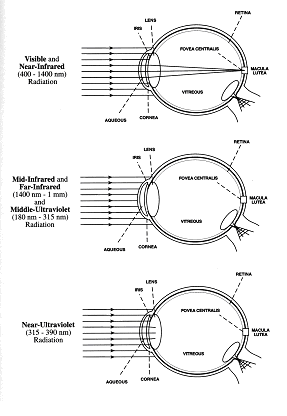
Images courtesy of LIA
Laser safety goggles, windows and barriers provide some levels of protection against injury from accidental and/or incidental direct or diffuse exposure to laser energy.
Laser Safety at a Glance
A Comprehensive Resource Booklet for Laser Safety
Ken Barat is the former Laser Safety Officer for Lawrence Berkeley Nat Lab and the National Ignition Facility Directorate. Presently, he is providing laser safety consulting under the title of Laser Safety Solutions. He is the author of four texts on laser safety as well as numerous articles and presentations worldwide. He is an OSA distinguished speaker, Fellow of the Laser Institute of America, and a senior member in IEEE and SPIE. He was the chair and organizer of the first seven LSO workshops. ANSI committee member and chair.
NoIR Laser
NoIR provides industry-defining protection and visibility for the world of laser applications. Made in the USA and CE-Certified, LaserShields® deliver performance and protection with an eye on comfort. With more than 125 filters and a frame to fit any face, LaserShields® are the point where Form and Function converge. All LaserShields® are produced in Southeast Michigan, where NoIR is committed to excellence in product quality and customer service.